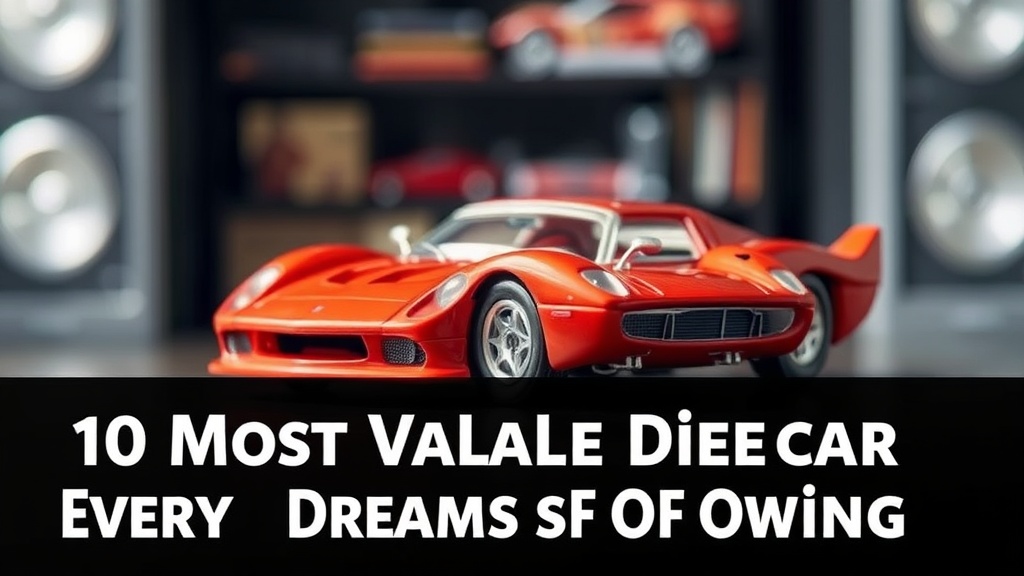
10 Most Valuable Diecast Cars Every Collector Dreams Of Owning

1969 Pink Rear-Loading Beach Bomb Hot Wheels
1982 Brown C-3PO Star Wars Diecast (No Country Stamp)
1956 Aston Martin DBR1 Corgi Toys Version
1968 Custom Camaro Hot Wheels with White Interior
1971 Purple Olds 442 W-30 Hot Wheels
Certain diecast models have achieved legendary status in the collector community — not merely as toys, but as appreciating assets that command five and six-figure prices at auction. This post examines ten of the most valuable diecast cars ever produced, breaking down what makes each piece extraordinary and why serious collectors actively hunt them. Whether you're evaluating an inherited collection or scouting for investment-grade pieces, understanding these benchmarks helps you recognize true rarity in a market flooded with mass-produced replicas.
What Makes a Diecast Car Truly Valuable?
Rarity, condition, and provenance drive value in the diecast market. Limited production runs — sometimes fewer than a dozen pieces worldwide — create immediate scarcity. Factory errors, pre-production samples, and models with documented ownership history (especially celebrity or designer provenance) command significant premiums.
The materials matter too. Early diecast cars from the 1950s and 1960s often used zamak alloy formulations that deteriorated over decades — a phenomenon collectors call "zinc pest." Surviving examples in pristine condition are extraordinarily rare. Packaging completeness affects value dramatically; a mint-in-box example might fetch ten times what a loose equivalent brings.
Here's the thing: the diecast market operates differently than fine art or traditional antiques. Values can spike when a manufacturer discontinues a line or when pop culture revives interest in a particular vehicle. The Heritage Auctions collectibles department regularly tracks these fluctuations, providing reliable benchmarks for serious collectors.
Which Diecast Brands Produce the Most Valuable Models?
Matchbox, Hot Wheels, Corgi, and Dinky dominate the high-value segment — though several boutique manufacturers have entered the premium market with pieces that rival vintage examples in price.
Matchbox's "1-75" series from the Lesney era (1953-1982) represents the holy grail for many collectors. Early models featuring gray plastic wheels, metal bases, and no windows (the so-called "no-glass" variants) routinely sell for thousands. The official Matchbox collector resources provide detailed production timelines that help authenticate these pieces.
Hot Wheels — despite being marketed as children's toys since 1968 — has produced some of the most expensive diecast cars ever sold. The "Sweet 16" original lineup, particularly the Custom Camaro and Beatnik Bandit in specific color variations, can command $10,000+ when found in original blister packs.
1. Hot Wheels "Cheetah" Python (1968) — Pink, White Interior
The story here involves a factory error that created instant rarity. Mattel originally planned to release this model as the "Cheetah" — then discovered that name was trademarked. The tooling was modified to "Python" mid-production, but a small batch of pink examples with white interiors escaped the factory before the change.
Perhaps six authenticated examples exist. One sold at auction in 2019 for approximately $18,000. The color combination — metallic pink with a white interior — never appeared in regular production, making authentication relatively straightforward for knowledgeable collectors.
2. Matchbox "Magirus-Deutz Crane" (1961) — Orange Body, Silver Crane
Lesney Products manufactured this model in several color variations. The orange body with silver crane variant represents a pre-production sample that never entered regular distribution. Factory workers reportedly took these home as souvenirs — a practice common in the era but strictly prohibited today.
The Magirus-Deutz Crane in this configuration has sold for over $13,000. The model demonstrates exceptional casting detail for its era, with a functional crane mechanism that actually extends and rotates. Most surviving examples show play wear; finding one with intact paint and working features requires patience — and serious capital.
3. Dinky "Pre-War" Model 22D Delivery Van (1936)
Meccano's Dinky Toys line predates most competitors, and pre-war examples represent the earliest commercially produced diecast vehicles. The Model 22D Delivery Van — produced in multiple liveries including Nestlé, Cadbury, and Sunlight Soap — featured cast lead bodies (zamak wasn't widely used until post-war production).
Condition challenges abound with these pieces. Lead casting techniques of the 1930s created porous metal prone to corrosion. Also, many were repainted by children over the decades. An authenticated, original-paint 22D in good condition can exceed $15,000 at specialized auctions like Vectis Auctions, which handles significant diecast collections regularly.
4. Hot Wheels "Rear-Loader Beach Bomb" (1969) — Pink
The Rear-Loader Beach Bomb represents Hot Wheels' most famous casting variation. The original design featured a surfboard loading through the rear window — but the narrow wheelbase and top-heavy load made the model incompatible with Mattel's racing track systems. The tooling was redesigned with a side-loading feature and wider stance.
A few pre-production "rear-loader" examples escaped into collector hands. The pink color — not produced for regular retail — commands the highest prices. One example sold privately for a reported $70,000 in 2019, making it among the most expensive diecast cars ever traded.
5. Corgi "James Bond Aston Martin DB5" (1965) — Gold, Ejector Seat Intact
Corgi's gold-painted DB5 became an immediate phenomenon upon release, capitalizing on Goldfinger's cinematic success. The model featured functional ejector seat, rotating license plates, and bulletproof shield — remarkable engineering for mid-1960s mass production.
Most surviving examples have lost their ejector seat figures or suffered paint deterioration. The gold paint Corgi used was particularly susceptible to "gold rash" — a speckled deterioration pattern. A mint-in-box example with all accessories and instructions recently sold for $4,200. The Corgi Toys Collector Club maintains detailed condition grading standards for these pieces.
6. Matchbox "BP Dodge Wreck Truck" (1965) — Green Body, Regular Wheels
This model illustrates how packaging variations create value tiers. The BP Dodge Wreck Truck appeared in standard "E" box packaging — but transitional examples exist in "F" series boxes with "E" series labels applied over the original printing. These "transitional" boxes represent genuine factory variations, not reproductions.
The green body color (as opposed to the more common yellow) indicates early production. Combined with the transitional packaging, values reach $3,000-$5,000. The towing hook and crane assembly — often broken or missing on played-with examples — must be present for top-tier pricing.
Comparative Value Analysis: Premium Diecast Segments
| Price Tier | Characteristics | Typical Examples | Market Liquidity |
|---|---|---|---|
| $500-$2,000 | Mint common variants, complete packaging | Standard Hot Wheels Redlines, common Matchbox Superfast | High — sells within 30 days |
| $2,000-$10,000 | Rare color variations, transitional packaging | Matchbox "1-75" oddities, Corgi Gift Set variations | Moderate — specialized auctions required |
| $10,000-$50,000 | Factory errors, pre-production samples | Pink Rear-Loader Beach Bomb, prototype castings | Low — private sales or premier auctions only |
| $50,000+ | Unique pieces, documented celebrity provenance | Designer prototypes, auction house one-offs | Very low — requires specialized brokerage |
7. Hot Wheels "Brown Custom Camaro" (1968)
The Custom Camaro launched the Hot Wheels brand in 1968 as part of the original "Sweet 16." While common color variations sell for modest premiums, the brown enamel version — produced in extremely limited quantities before the color was discontinued — represents genuine scarcity.
Brown was an unpopular choice for children's toys. Mattel quickly pivoted to brighter colors, making brown examples rare almost immediately. A brown Custom Camaro in original blister pack sold for $6,000 in 2021. The catch? Reproduction blister packs exist, requiring authentication expertise to detect.
8. Matchbox "Mercedes 230SL" (1967) — Apple Green, Opening Doors
Lesney's Series 20 models introduced opening features that revolutionized diecast play value. The Mercedes 230SL appeared in multiple colors, but the apple green variant with intact door springs commands particular attention. The spring mechanism — a delicate wire component — typically corroded or broke with use.
Finding an apple green 230SL with functional doors and minimal paint wear requires examining dozens of examples. Values of $2,500-$4,000 are common for authenticated specimens. The model demonstrates Lesney's engineering philosophy: simple mechanisms that enhanced play without compromising durability.
9. Dinky "French Factory" Simca 1000 (1963)
Meccano operated factories in multiple countries, and regional variations create collecting niches. The French-produced Simca 1000 featured different base plates, wheel types, and paint formulations than its British equivalent. These variations weren't documented at the time — collectors discovered them through decades of comparative study.
The French Simca 1000 in metallic blue with silver interior — never catalogued in contemporary price guides — emerged as a significant variant in the 1990s. Examples rarely surface; when they do, European collectors aggressively pursue them. Recent sales have exceeded $5,000 for mint examples.
10. Schuco "Piccolo" Mercedes-Benz Renntransporter (1955)
German manufacturer Schuco produced exquisitely detailed micro-models long before diecast became a mainstream collecting category. The Piccolo series — approximately 1:90 scale — featured the Mercedes-Benz "Blue Wonder" racing transporter in multiple configurations.
The Renntransporter with complete loading ramps and intact plastic windows (the latter prone to yellowing and cracking) represents the pinnacle of Schuco collecting. Values have accelerated dramatically as German automotive heritage collecting grows globally. Expect to pay $8,000-$12,000 for museum-quality examples.
How Can Collectors Authenticate High-Value Diecast Cars?
Authentication requires examining multiple attributes: casting marks, paint texture, wheel types, and base plate stampings. Factory-original paint has a specific "feel" — slightly soft, with subtle orange-peel texture that modern reproductions rarely replicate.
Base plate markings reveal production dates and factory origins. Lesney Matchbox models feature "patent pending" markings that transitioned to specific patent numbers — dating pieces to narrow production windows. Hot Wheels base plates include manufacturing location codes that help identify genuine vintage pieces.
Packaging authentication presents additional challenges. Original blister packs from the 1960s and 1970s used specific plastic formulations that develop characteristic yellowing patterns. Modern reproduction packaging often uses incorrect font spacing or cardboard thickness. The Toy Mart price guide maintains visual reference libraries for authentication purposes.
Worth noting: provenance documentation significantly impacts value. Original purchase receipts, auction catalogs, or authentication letters from recognized experts add credibility — and dollars — to any high-value transaction. The diecast market remains vulnerable to sophisticated reproductions; purchasing from established dealers with return privileges protects against costly mistakes.
"The difference between a $50 diecast car and a $5,000 example often comes down to manufacturing tolerances measured in thousandths of an inch. These weren't precision instruments — they were toys. That imperfection is precisely what makes genuine vintage pieces identifiable." — Julian Thorne, The Diecast Archive
The hunt for valuable diecast cars rewards patience, knowledge, and a willingness to examine thousands of ordinary pieces before finding the extraordinary one. Every collection — regardless of current value — might contain that single variation that transforms a casual hobby into a significant financial return. Keep hunting.