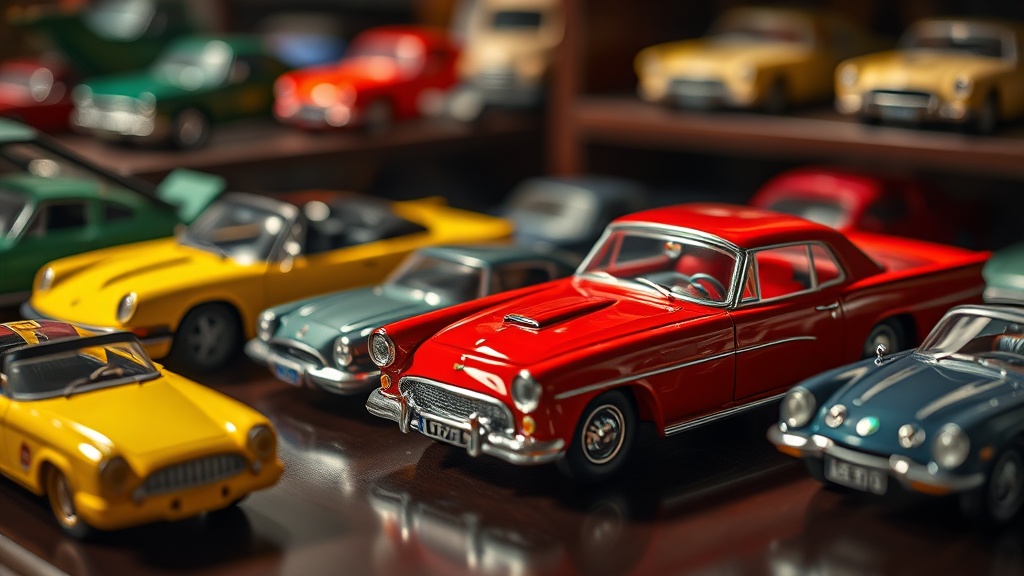
5 Iconic Diecast Cars Every Serious Collector Needs in Their Display

1969 Chevrolet Camaro Z28
1973 Porsche 911 Carrera RSR
1967 Ford Mustang Shelby GT500
1984 Ferrari Testarossa
1955 Mercedes-Benz 300 SL Gullwing
The diecast market has evolved from childhood playthings to serious investment-grade collectibles, with certain models now commanding prices that rival their full-scale counterparts. This post examines five specific diecast vehicles that represent essential additions to any serious collection, analyzing manufacturing quality, historical significance, and long-term value retention. Each selection demonstrates the engineering precision and attention to detail that separates museum-grade pieces from mass-market commodities.
1. The 1967 Ferrari 275 GTB/4 in 1:18 Scale by CMC Models
Ferrari produced only 330 examples of the 275 GTB/4 between 1966 and 1968, making the original automobile one of the most coveted front-engine V12 Ferraris ever built. CMC Models has replicated this vehicle with a level of detail that approaches forensic accuracy. The model contains approximately 1,800 individual parts, assembled over 450 distinct production steps.
The diecast body shell measures 0.8mm thick, providing substantial heft without sacrificing surface detail resolution. CMC employs photo-etched brass for the wire wheels, with each spoke individually soldered to create the characteristic Borrani wheel pattern. The wire spoke count matches the original: 72 spokes per wheel, 288 total across the model.
Opening components include both doors, the hood, trunk, and fuel filler cap. The engine bay reveals a fully detailed Colombo V12 with individual throttle bodies, spark plug leads, and cooling system plumbing. The distributor cap contains 12 separate leads, each terminating at the correct cylinder position. The value proposition remains strong: original MSRP was approximately $450 in 2015; current secondary market values range from $600 to $800 depending on condition and provenance.
For display purposes, collectors should note the model's weight of 3.2 pounds (1.45 kg). A reinforced shelf or dedicated pedestal display is recommended to prevent structural stress on standard shelving units.
2. The 1968 Chevrolet Camaro Z/28 in 1:64 Scale by Hot Wheels Redline
The 1968 Hot Wheels Redline Camaro represents the intersection of American muscle culture and diecast history. Mattel produced this casting during the original "Sweet Sixteen" release period, with production spanning from 1968 to 1971. The original Redline series derives its name from the red stripe applied to the tire sidewalls—a detail that required a separate production step at the factory level.
Early production examples feature the "Hong Kong" base marking and are distinguished by a bearing-type wheel construction. These wheels contain a brass eyeletted axle riding on a plastic bearing surface, allowing significantly smoother rolling action than contemporary competitors. The base material transitioned from zinc alloy to ABS plastic in later production runs, creating distinct variations for collectors to track.
Color variations determine value hierarchy:
- Custom Orange (1968): $800-$1,200 in mint condition
- Custom Antifreeze (1968-1969): $400-$600
- Creamy Pink (1969): $300-$450
- Olive (1970): $150-$250
The casting itself measures 3 inches (76mm) in length and features an opening hood mechanism that reveals a detailed small-block V8. The chassis contains the "USA" patent number 3,237,323, referencing Mattel's original spring suspension system. Serious collectors seek examples with intact suspension springs and uncracked "Spectraflame" paint finishes—the latter achieved through a transparent lacquer applied over a polished zinc body.
3. The 1963 Shelby Cobra 427 in 1:12 Scale by GMP
Carroll Shelby built only 348 examples of the 427 Cobra between 1965 and 1967. GMP (Georgia Marketing & Promotions) produced their 1:12 scale replica in limited quantities during the early 2000s, with specific production runs rarely exceeding 2,500 units per color variation. This scale allows for details impossible to achieve in smaller formats.
The model features a complete tubular frame recreation visible through the opening hood and doors. The frame rails measure 2mm in diameter at scale—equivalent to 4-inch tubing on the actual vehicle. The side pipes are individually chromed metal pieces, not painted plastic, with opening baffles that reveal internal baffling patterns.
Interior details include functional toggle switches on the dashboard, braided stainless steel lines for the fuel and oil systems, and a full leather upholstery treatment with visible stitching patterns matching the original Diebenorn & Associates interior specifications. The trunk contains a spare tire mounted on a period-correct magnesium wheel and a battery with proper lead-acid cell detailing.
The steering mechanism connects to the front wheels with a working rack-and-pinion system that moves 28 degrees in either direction. This mechanical accuracy extends to the suspension, where functional coilovers compress and rebound through their full travel range. The original retail price was $189; complete, boxed examples now trade between $400 and $900 depending on color and edition.
4. The 1971 Nissan Skyline GT-R "Hakosuka" in 1:43 Scale by Ebbro
Ebbro, a Japanese manufacturer specializing in domestic market vehicles, has produced the definitive small-scale replica of the original GT-R. The KPGC10 chassis Skyline earned its "Hakosuka" nickname (roughly "boxy Skyline") from its angular body lines. Nissan built 1,945 units of the GT-R variant between 1969 and 1972.
The Ebbro model captures details specific to early Japanese manufacturing that Western manufacturers often overlook. The window trim uses vacuum-metallized plastic with a thickness of 0.15mm—thin enough to maintain scale appearance but durable enough for handling. The "GT-R" fender badging is photo-etched metal, not printed decals, with proper dimensioning of 12mm x 4mm at scale.
Engine bay accessibility requires removal of the hood using small magnets rather than visible hinges—a design choice that maintains body line integrity. Underneath, the S20 inline-six engine shows individual intake trumpet detailing and triple Weber carburetor linkages. The twin-cam valve covers carry the correct "Nissan" and "S20" script markings.
Paint quality deserves particular mention. Ebbro employs a two-stage painting process with clear coat thickness of approximately 40 microns, providing depth without obscuring panel gaps. The original retail price of ¥8,500 (approximately $75) has appreciated to $120-$180 for desirable color combinations like Grand Prix White and Lime Green.
5. The 1988 Porsche 959 in 1:18 Scale by AutoArt
The Porsche 959 represented the technological pinnacle of 1980s automotive engineering, with only 292 production examples completed between 1986 and 1993. AutoArt's composite model—utilizing a diecast metal base with ABS plastic body panels—demonstrates how modern manufacturing techniques can achieve superior surface detail compared to traditional all-metal construction.
The body panel gaps measure 0.3mm consistent around all openings, achievable through computer-guided molding processes. The iconic "Fuchs" wheels are reproduced with separate magnesium-colored centers and dark gray barrels, secured with visible hex bolts. Each wheel contains 16 air vents, individually tooled and free of casting flash.
Functional elements include:
- Headlights with opening covers actuated by small levers in the interior
- Adjustable ride height suspension using actual coil springs
- Opening engine cover revealing the twin-turbo flat-six with individual intercooler plumbing
- Functional steering wheel connected to the front wheels
Interior accuracy extends to the correct fabric weave pattern on the seats—reproduced through laser-etched tooling—and the complete gauge cluster with 300 km/h speedometer and 7,000 RPM tachometer. The dashboard contains the original "PSK" (Porsche-Steuer-Kupplung) all-wheel-drive selector controls, non-functional but dimensionally accurate.
Weight distribution benefits from the composite construction: 1.9 pounds (860g) with balanced front-to-rear distribution. The model sits on a rubberized base in its original packaging, preventing paint contact with display surfaces. Original MSRP was $220 in 2018; current market values range from $250 to $350.
Care and Display Considerations
These investments require specific environmental controls. Direct sunlight causes paint fading and plastic degradation—UV-filtering display cases are non-negotiable for long-term preservation. Temperature stability between 65-75°F (18-24°C) prevents metal expansion stress on plastic components. Relative humidity should remain between 45-55% to prevent corrosion on photo-etched brass and steel components.
Dust accumulation represents the primary maintenance concern. Compressed air at 15 PSI maximum pressure removes particulates without mechanical contact. For stubborn deposits, microfiber cloths lightly dampened with distilled water avoid mineral spotting. Never apply household cleaners containing ammonia or alcohol—these compounds attack clear coat finishes and plastic windows.
The five vehicles listed above represent different scales, price points, and manufacturing philosophies. Together, they demonstrate the breadth and depth available to serious collectors. Each model serves as a three-dimensional document of automotive history, preserved with the precision that these machines deserve.