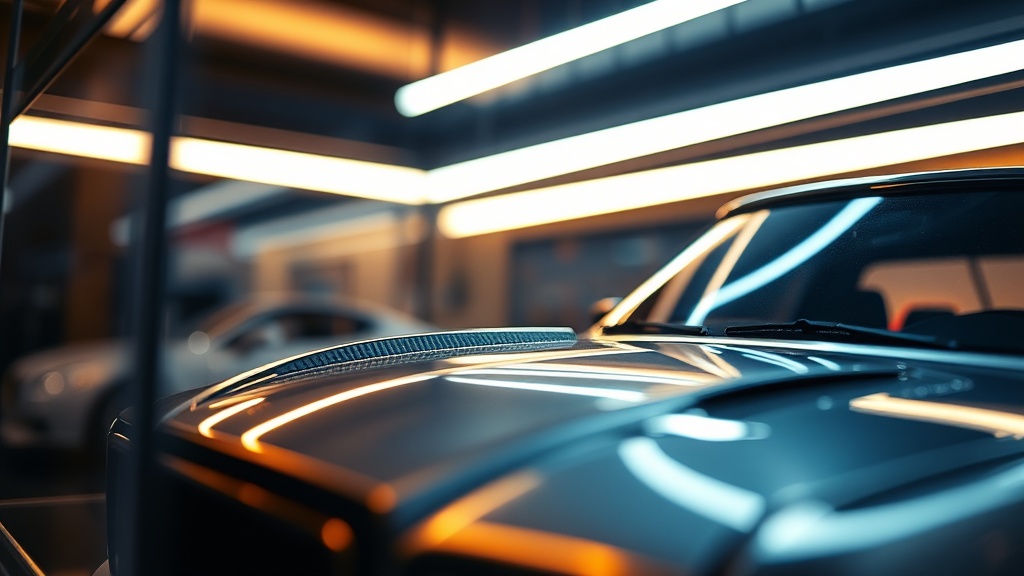
Display Lighting for 1:18 Diecast: CRI, Color Temperature, and the Details You Are Missing

The Unforgivable Sin of Bad Lighting
I have walked into collections worth six figures and felt nothing. Not because the models were wrong — the opposite, usually — but because every piece was drowning in the wrong light. Warm-white LEDs casting a jaundice-yellow wash over a Biante Holden Commodore that should be reading candy apple red. Cool-white strips turning CMC's hand-stitched leather interiors into something that looks vacuum-sealed in a hospital. The models were flawless. The presentation was a crime scene.
Lighting is the single most consequential display decision you will make, and it is the one most collectors treat as an afterthought. I know because I spent my first eight years as a collector doing it wrong.
Color Rendering Index: The Number That Actually Matters
Forget lumens. Forget wattage. The number you need tattooed on your forearm is CRI — Color Rendering Index. It measures how faithfully a light source reproduces colors compared to natural sunlight, scored from 0 to 100. Sunlight is 100. The cheap LED strips from the hardware store sit around 70-80. That gap is where your Rosso Corsa Ferrari starts looking like a faded brick.
For diecast display, I will not install anything below CRI 95. Full stop. At 95+, you start seeing the metallic flake in AUTOart's paint. You start distinguishing the subtle difference between the matte black of a mirror housing and the semi-gloss black of a wiper arm on a CMC piece. Below 95, those distinctions collapse into a single muddy tone, and the model loses a full dimension of visual complexity.
The sweet spot for color temperature is 4000K — neutral white. Not the 2700K "warm" that residential lighting defaults to, which pushes everything amber. Not the 5000K-6500K "daylight" range, which can make metallic paint look chalky and sterilized. At 4000K, you get faithful color reproduction without the clinical edge. Silver reads as silver. British Racing Green reads as British Racing Green. Not "greenish-grey," not "olive-maybe."
Angle of Attack
The second failure point is direction. Overhead lighting — the kind built into most commercial display cabinets — creates what I call the "autopsy effect." Light hits the roof panel, the hood, and the trunk lid hard, while the entire flank of the car falls into shadow. You lose shut lines, you lose wheel detail, you lose everything that makes a profile view interesting.
What you want is a combination of angled top lighting and subtle side illumination. I run two lighting channels in every shelf of my Detolf cabinets: a primary strip mounted at the front lip of the shelf above, angled backward at roughly 30 degrees, and a secondary strip at the rear. The front strip catches the hood, the A-pillar, and the forward fender line. The rear strip fills in the trunk, the C-pillar, and — critically — provides enough light to read the rear badging and exhaust detail without having to press your face against the glass like a kid at a dealership window.
The ratio matters. I run the front channel at roughly 70% brightness and the rear at 40%. If you go equal, you flatten the model. If you go too extreme, you get theatrical shadows that look impressive for photographs but are annoying to live with. The point of a display is sustained viewing over years, not a single glamour shot for Instagram.
The UV Question
Every collector who has been around long enough has a horror story about UV damage. Paint fade on a tampo-printed livery. Yellowed clear coats on white models. The slow, invisible death of pigment stability. LEDs produce negligible UV compared to halogen or fluorescent sources, which is one of the genuine reasons to have switched over a decade ago. But "negligible" is not "zero."
I add a UV-filtering film to the glass on any case that receives ambient window light. This is not optional in my gallery — every case within eight feet of a window gets the treatment. The film is cheap, around twelve dollars per sheet, and it is the single best insurance policy you can buy for a collection. I have models from 2006 sitting under filtered glass that show zero measurable fade. Identical models in an unfiltered case by my office window have visible color shift on the roof panel after four years.
For LED strips specifically, look for products that explicitly state "no UV emission" rather than "low UV." The distinction exists, and the manufacturers who make the effort to eliminate UV entirely tend to also care about CRI, which brings you back to the right product category anyway.
Heat: The Invisible Destroyer
LEDs run cool compared to halogen, but "cool" is relative. A strip drawing 14 watts per meter inside a sealed glass cabinet with no ventilation will raise the internal temperature by 5-8°F over ambient within two hours. That temperature differential accelerates every degradation process that affects diecast: tire rubber drying, adhesive softening on applied details, and — in extreme cases — the gradual warping of thin plastic components like side mirrors and antenna masts.
I ventilate every display cabinet. Two 40mm fans per case, one low and one high, running on a silent 5V supply. The airflow is imperceptible — you cannot feel it on your hand — but it is enough to equalize the internal temperature with the room. My cases run within 1.5°F of ambient, confirmed by the small digital thermometer-hygrometers I keep on every other shelf. Twenty dollars each, and they have saved me from two incidents where a failed fan would have gone unnoticed.
What I Actually Use
For the record, my current setup runs Yuji LED strips — the BC Series, CRI 95+, 4000K neutral white. I have been using them since 2021 and have not found a reason to switch. They are not the cheapest option. A 5-meter roll runs about forty-five dollars. But the color accuracy is exceptional, and the output is consistent strip to strip, which matters when you are running sixty-plus meters of the stuff across an entire gallery wall.
The drivers are Meanwell LPV-series, which are dimmable, silent, and overbuilt. I have one driver per four shelves, and I have never had a failure. The dimming is handled by a simple PWM controller — nothing smart-home, nothing app-controlled. A physical dial on the wall. When I want to adjust the light, I turn a knob. Revolutionary, I know.
For UV film, I use Gila Titanium window film, applied wet with a squeegee. It blocks 99% of UV and has a neutral tint that does not discolor the view through the glass. I replace it every five years as a precaution, though I have never measured degradation in the film itself within that timeframe.
The Test That Changed My Mind
Three years ago, I ran a controlled comparison that settled the lighting question permanently for me. I placed two identical AUTOart Lamborghini Centenario models — same production run, consecutive serial numbers — in adjacent cases. One under my CRI 95+ / 4000K setup. One under a standard CRI 80 / 3000K warm-white strip from a big-box store.
After twenty-four hours of viewing, I invited four fellow collectors to examine both without telling them which was which. Every single one identified the 95+ case as having a "better" or "more detailed" model. One of them asked if the CRI 80 model was a different, cheaper version. Same model. Same paint. Same factory. The only variable was the light falling on it.
Your collection deserves to be seen the way the engineers intended when they approved the final paint sample under controlled studio lighting. Anything less, and you are paying premium prices for models that present like mid-tier shelf fillers. And that, to me, is the real waste of money in this hobby — not what you spend on the model, but what you refuse to spend on showing it properly.