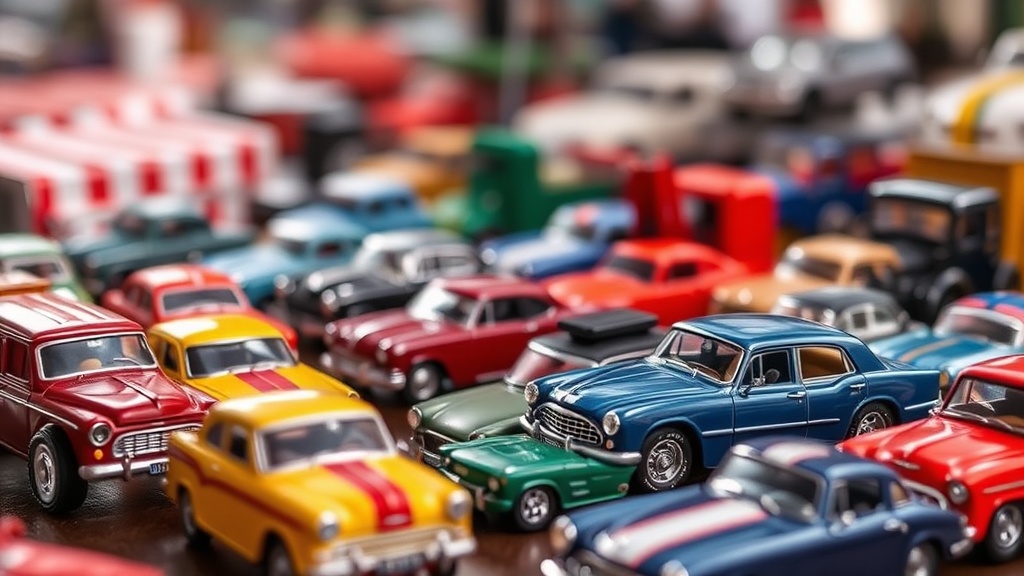
How to Spot Valuable Diecast Cars at Flea Markets and Garage Sales

This post covers the practical skills needed to spot valuable diecast cars buried in cardboard boxes at flea markets and garage sales—and why those skills matter. The diecast market has grown into a serious collecting arena where a single $1 purchase can turn into a $200 sale. Whether you're hunting for vintage Redlines, rare Treasure Hunts, or forgotten European castings, knowing what to look for (and what to ignore) will save you time, money, and regret.
What Makes a Diecast Car Valuable?
Rarity, condition, and provenance. That's the short answer. The longer answer involves understanding production runs, packaging variations, and the subtle manufacturing details that separate a common shelf piece from a collector's grail.
Diecast value isn't arbitrary—it's driven by supply, demand, and authenticity. A 1969 Hot Wheels Beach Bomb in pink, for example, commands five figures because Mattel produced very few in that color before switching to a wider-loading design. Conversely, a 1995 Matchbox Ford Escort might sit in bins for years because millions were cast. The difference comes down to scarcity and cultural relevance. Cars tied to real motorsport history, limited retail exclusives, and castings with documented factory errors tend to appreciate fastest.
Condition grading matters just as much as the model itself. Mint-in-box examples routinely outsell loose cars by 300% or more. That said, a loose car with perfect paint, straight axles, and intact wheels can still pull strong money if the casting is rare enough. Here's the thing: most sellers at garage sales don't know collector jargon. They'll call a scratched Redline "old" and price it at fifty cents. That's where your eye for detail pays off.
How Can You Tell Real Hot Wheels Treasure Hunts from Regular Releases?
Look for the flame logo, Spectraflame paint, or a "TH" symbol hidden somewhere on the casting.
Hot Wheels Treasure Hunts—introduced by Mattel in 1995—are intentionally limited-production releases mixed into standard cases. Regular Treasure Hunts typically feature a small flame logo behind the vehicle on the card art, while Super Treasure Hunts upgrade the casting with premium rubber tires, detailed tampos, and Spectraflame finishes. The catch? Scalpers and uninformed sellers often mislabel mainline cars as Treasure Hunts based on color alone.
When inspecting loose cars, flip the base over. Super Treasure Hunts usually have a "TH" stamped or tampoed somewhere on the body—under the spoiler, inside the door panel, or on the rear bumper. The wheels are another giveaway: standard mainlines use simple one-piece plastic wheels, but Supers ride on Real Riders—rubber tires with detailed rims. If you spot a 1969 Dodge Charger in metallic orange with treaded tires sitting in a $2 bin, grab it.
Worth noting: not every valuable Hot Wheels release is a Treasure Hunt. Zamacs (bare-metal Walmart exclusives), RLC (Red Line Club) memberships cars, and vintage Sweet Sixteen castings from 1968 all trade independently of the Treasure Hunt program. Keep a mental checklist. Better yet, bookmark the Hot Wheels Wiki on your phone for quick reference in the field.
Where Should You Look First at a Flea Market or Garage Sale?
Start with the bins under the table and the plastic tubs marked "toys"—that's where undervalued diecast usually hides.
Sellers often display their best items on tablecloths at eye level. Those are fine to browse, but they're also priced with Google in mind. The real deals live in chaos: overstuffed shoeboxes, Ziploc bags full of mixed castings, and tubs labeled "kids' stuff." A 1971 Redline Heavy Chevy has just as much chance of sitting in a Walmart bag as it does on a velvet display pad. Sometimes more.
Ask questions. Not collector questions—casual ones. "Where'd these come from?" or "Are you clearing out a relative's attic?" Answers reveal provenance. Estate sales are goldmines because families sell entire collections without inventorying them. Flea markets like the Rose Bowl Flea Market in Pasadena or local swap meets attract dealers who know pricing, but they also attract casual vendors who bought a storage unit at auction and want quick cash.
Timing matters too. Arrive early for organized estate sales. At flea markets, the last hour of the day often brings discounts—sellers don't want to pack unsold inventory back into their trucks. Don't be shy about bundling. A box of twenty mixed cars priced at $40 often drops to $25 if you pay cash and carry it away immediately.
Which Brands Hold the Most Resale Value?
Not all 1:64 scale metal is created equal. Some brands dominate the secondary market; others struggle to break $5 regardless of age. The table below breaks down how major diecast manufacturers compare for collectors hunting resale profit.
| Brand | Era to Target | Key Value Drivers | Typical Resale Range (Loose) |
|---|---|---|---|
| Hot Wheels | 1968–1977 (Redlines), 1995–present Treasure Hunts | Redline tires, Spectraflame paint, factory errors | $5 – $5,000+ |
| Matchbox | 1953–1982 (Lesney era) | Superfast wheels, "Made in England" base stamps | $3 – $800 |
| Corgi Toys | 1956–1983 | Working features (e.g., Golden Jack), gift set packaging | $10 – $1,200 |
| Dinky Toys | 1934–1979 (Meccano era) | Pre-war castings, French factory models | $15 – $3,000+ |
| Johnny Lightning | 1994–2004 (Playing Mantis / JLRC) | White Lightning variations, limited runs | $5 – $300 |
| Tomica | 1970–1990s (Japan domestic) | Made-in-Japan base stamps, box art variations | $4 – $150 |
Hot Wheels and Matchbox dominate volume, but Dinky and Corgi dominate prestige. European castings—especially French Dinky and Corgi Batmobiles—regularly outperform American counterparts at auction because fewer survived in mint condition. Johnny Lightning White Lightnings are trickier: they're unmarked variations (white tires, white interiors, white chassis) that collectors obsess over. If you spot a 1969 Chevy Camaro with white tires in a bulk lot, you've found something special.
What Physical Condition Red Flags Should You Ignore—or Walk Away From?
Ignore minor paint chips on ultra-rare castings, but walk away from bent axles, cracked windshields, and corroded zinc pest.
Condition grading scales vary by community, but most collectors use a spectrum from Mint (perfect) to Poor (heavy play wear, missing parts). At flea markets, you'll see everything. The trick is knowing which flaws are fixable and which ones destroy value. Light paint chips on a 1970s Redline? Disappointing, but acceptable if the price is right. A cracked windshield on a Corgi Aston Martin DB5? That usually kills the premium because replacement parts are hard to source and rarely match factory tint.
Zinc pest is the silent killer. It's a chemical reaction in the zamak alloy base that causes bubbling, cracking, and eventual disintegration. Look closely at the base and wheel arches. If the metal looks swollen or flaking like old plaster, the car is terminal. No restoration fixes zinc pest. Bent axles are another headache—they're technically repairable, but straightening them without damaging the wheels takes patience and specialized tools. For common cars, it's not worth the effort.
Check the wheels carefully. Redline tires should show solid red stripes without cracking or fading. Real Riders rubber should still feel pliable, not rock-hard or melted. Missing wheels drop a car straight into "parts" territory unless the body itself is rare. That said, some collectors buy parts cars intentionally to complete restorations. If a 1968 Custom Corvette has perfect Spectraflame paint but no wheels, it still has value—just priced accordingly.
Original packaging is a massive value multiplier. A blister card with unpunched hanging tabs, clear bubble, and no price sticker can double or triple the car's worth. Unfortunately, most flea market finds are loose. When you do find carded examples, inspect the bubble for yellowing, cracking, or separation from the card. "Carded but cracked bubble" is a common middle ground—still collectible, just not investment-grade.
"The best finds aren't the ones on display. They're the ones the seller forgot they had."
Final advice: bring a jeweler's loupe or a phone with macro photography capability. Factory errors—tampo misprints, missing paint applications, upside-down decals—are easy to miss at a glance but highly sought after. A 1995 Treasure Hunt Mustang with a missing side tampo might look defective to a casual eye, but to error collectors, it's a prize. Similarly, wheel variations (commonly called "errors" in the community) can add 50% or more to resale value.
Keep cash on hand. Small bills. Many garage sale vendors won't take Venmo, and ATMs at flea markets charge ridiculous fees. Move fast when you spot something good—another collector is usually three tables behind you. And remember: the goal isn't to win every table. The goal is to build the judgment that lets you recognize the one car everyone else overlooked. That's the difference between a hobbyist and a curator.
Happy hunting.