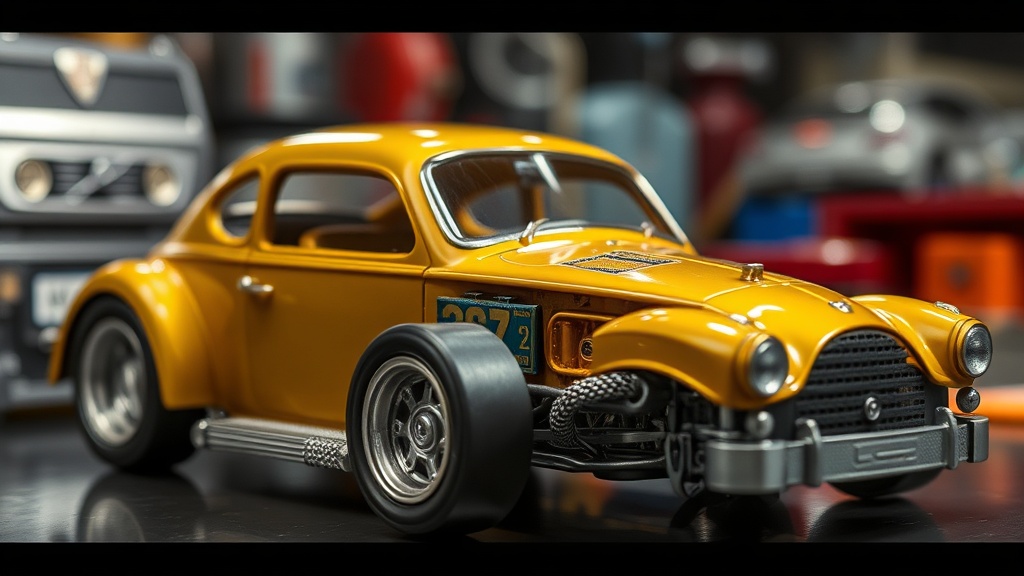
Identifying High-Grade Diecast via Casting Precision and Part Fitment

Why Casting Defects Aren't Always Just Surface Flaws
Most collectors assume that a tiny bit of uneven paint or a slight gap in the chassis is just a sign of a "cheap" toy. They're wrong. In the world of high-end diecast collecting, those imperfections often tell the real story of the manufacturing process. A gap in a door seam isn't just a cosmetic issue; it's a measurement of the tooling's longevity and the precision of the injection molding. When you look at a model, you shouldn't just see a car; you should see the tolerances of the die-cast metal itself. Understanding how to differentiate between a factory-intended variation and a structural failure in the tooling is what separates a casual hobbyist from a true connoisseur.
When we talk about high-grade models, we're talking about pieces where the engineering-to-scale ratio is near perfect. A high-quality casting will have crisp, sharp edges on the body lines. If a fender looks rounded or-heaven forbid-blurry, you're likely looking at a worn-out die or a lower-grade production run. This isn't just about aesthetics; it's about the integrity of the mold. A sharp mold produces a sharper product. If the lines are soft, the metal wasn't held at the right pressure, or the die was too old to maintain its edge. This is where the technical eye becomes your best tool.
What Defines High-Quality Diecast Part Fitment?
Fitment is the ultimate test of a model's quality. If you're looking at a premium model, the way the chassis meets the body—the "shut lines"—should be uniform. If one side of a hood has a 0.5mm gap and the other has 1.5mm, you've found a manufacturing inconsistency. This often happens when the assembly process isn't as precise as the casting itself. Even if the metal body is perfect, a poorly fitted baseplate can ruin the silhouette of the car.
Check these specific areas to judge fitment quality:
- Wheel Wells: The clearance between the tire and the fender should be consistent. If the wheel is rubbing or sits too high, the axle assembly was likely an afterthought.
- Door and Hood Seams: Look for consistent gaps. A high-end model's doors should sit flush with the bodywork, leaving almost no visible light through the seam.
- Glass Integration: The way the clear plastic windows meet the metal body is a major indicator of quality. Gaps here suggest a lack of precision in the multi-part assembly.
For those interested in the technical side of how these parts are actually manufactured, the Britannica entry on die casting provides a deep look into the physical properties of metal casting that governs these results. It's not just about pouring metal; it's about thermal dynamics and pressure.
Does Paint Quality Determine Value?
It's a common mistake to think that a shiny car is always a good car. Paint is a chemical layer, and in diecast, it's often the first thing to fail. A high-quality paint job isn't just about the shine; it's about the adhesion and the lack of "orange peel" texture. Orange peel—that bumpy, uneven texture often seen on cheap plastic or metal—is a sign of a rushed or low-quality spray process. A truly premium model will have a finish that looks as smooth as a mirror, reflecting light in a straight, unbroken line.
You also need to watch for paint bleed. This happens when the paint from one part (like a black trim piece) seeps into the colored part of the car. It's a sign of poor masking during the painting stage. If you see paint in the crevices where it shouldn't be, the production quality was sacrificed for speed. Collectors should always look for clean, sharp boundaries between colors. This is a hallmark of a high-end production run.
How Do You Spot Poorly Made Accessories and Trim?
The real detail is in the small stuff. I'm talking about the photo-etched parts, the plastic wipers, and the tiny interior details. In many mid-tier models, the interior is just a single piece of molded plastic. In high-end pieces, you'll see separate parts for the dashboard, steering wheel, and seats. This level of detail requires more complex assembly but results in a much more realistic-looking product. If the steering wheel looks like a single blob of plastic rather than a distinct component, you're looking at a lower-tier model.
One thing to keep in mind is the weight and the material of these accessories. High-end models often use a mix of materials—metal for the chassis, high-grade ABS for the interior, and perhaps even rubber for the tires. If a car's "tires" are actually hard plastic, the value and the realism drop significantly. A high-quality model should feel substantial, not hollow. This weight is often a result of a metal-heavy construction versus a plastic-heavy one.
"Precision is not an accident; it is the result of high-tolerance tooling and a rigorous manufacturing process." — The Diecast Archive
To understand the material standards often used in these high-end builds, you can research the physical properties of various alloys via ScienceDirect, which can help you understand why certain metals are preferred for durability and detail. Understanding the science behind the metal helps you appreciate the craft behind the model.
When you're examining a new piece for your collection, don't just look at the overall shape. Zoom in. Use a jeweler's loupe if you have to. Look at the thickness of the paint on the edges, the tightness of the screw heads, and the way the light hits the curves. If the edges are soft and the gaps are uneven, it doesn't matter how pretty the color is—the engineering isn't there. A true masterpiece of a diecast model is a triumph of precision, not just a pretty object on a shelf.