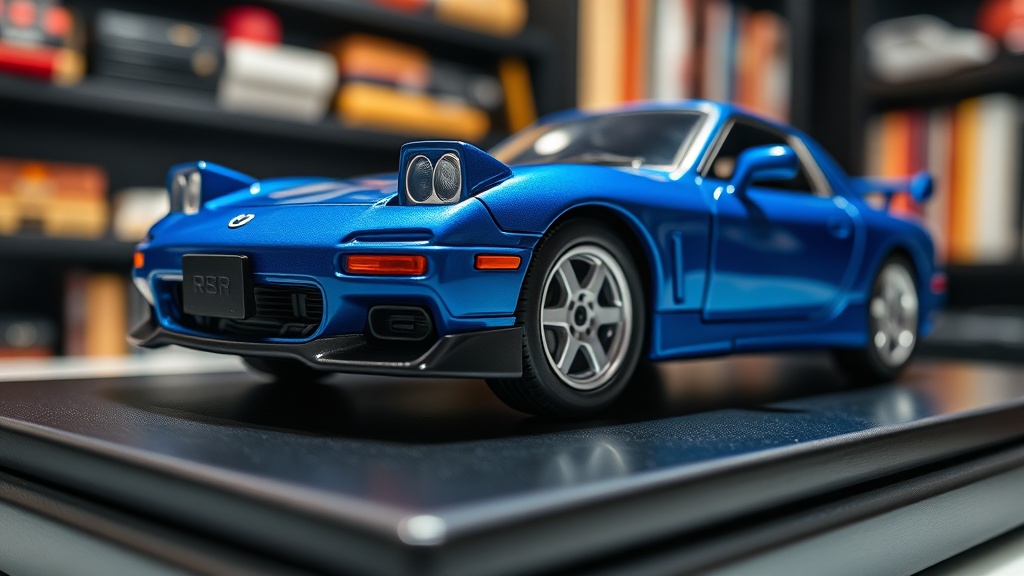
Manufacturer Spotlight — Ignition Model: The Case for Sealed Resin Done Right

Manufacturer Spotlight — Ignition Model: The Case for Sealed Resin Done Right
Regular readers know my position on sealed resin. I have spent three years refusing to add a full-resin piece to my primary collection, and I have written publicly about why articulation defines engineering integrity in 1:18. So when I tell you that Ignition Model is the single exception I keep making room for on my shelves, understand that this is not a reversal. It is a concession earned through obsessive detail work that most resin producers cannot match.
Who They Are
Ignition Model is a Japanese manufacturer based in Yokohama, producing limited-run resin models with an almost exclusive focus on JDM — Japanese Domestic Market — vehicles. Their catalog reads like a period-correct walk through the back lots of Daikoku Futo: Nissan Skylines, Mazda RX-7s, Toyota Supras, Nissan Fairladys, and deep-cut tuner variants that no European or American manufacturer would touch. They also produce in 1:43 and 1:64, but my interest — and this review — centers on their 1:18 output.
What separates Ignition from the resin pack is their production method. They 3D-scan actual vehicles and then refine those scans into tooling data. This is not a designer approximating a fender line from reference photos. The proportional accuracy that results is immediately apparent when you set an Ignition Fairlady Z next to a competitor's attempt at the same car. Lines that should be taut are taut. The greenhouse sits where it should sit. The stance is correct.
The Detail Standard
I evaluate every 1:18 piece against three criteria: surface finish consistency, shut line precision, and component fidelity. Ignition's surface work is among the best I have handled in resin. Their paint applications are deep, even, and free of the orange peel that plagues lower-tier resin houses. On a recent Toyota Mark II 2.5GT Twin Turbo, the metallic flake distribution under magnification is uniform to a degree that suggests multiple coats with proper flash time between layers — the kind of protocol I would have insisted on in my manufacturing days.
Their headlamp assemblies deserve specific mention. Where most sealed resin producers treat lighting units as a flat decal behind clear plastic, Ignition builds depth into the reflector housing. On their Fairlady Z pieces, you can see individual reflector facets inside the headlamp unit. This is the kind of detail that separates a model engineer from a model assembler.
Shut lines on a sealed body are, by definition, cosmetic rather than functional. But they still tell you something about the manufacturer's standards. Ignition's panel gaps are consistent and scaled appropriately. They do not suffer from the oversized gap problem that makes some sealed models look like they were assembled from two slightly different molds.
The JDM Gap in the Market
Here is the practical reality that keeps Ignition relevant to serious collectors: nobody else is doing this work. If you want a properly rendered 1:18 Nissan Leopard, an R30 Skyline in a period-correct Tomica livery, or a tuned FD3S RX-7 with Mazdaspeed aero, Ignition is not one option among many. They are the only option. Kyosho's Samurai line covers some JDM ground in resin, but with less detail density. AUTOart has largely abandoned the JDM segment at this scale. Nobody at CMC or Exoto is looking at a Mazda Cosmo Sport and thinking about production viability.
This monopoly position is both their strength and a collector concern. Ignition's limited production runs — typically between 100 and 300 units for 1:18 — mean that secondary market prices escalate quickly. A model that retailed for $280 can clear $500 within eighteen months of selling out. This creates a speculation dynamic that I find distasteful but cannot ignore as a market reality.
Where They Fall Short
I would be dishonest if I presented Ignition as flawless, and dishonesty has no place in this practice.
First, these are sealed resin. Nothing opens. No doors, no hood, no trunk. For a collector like me who believes that a model's engineering should be testable — that you should be able to open a hood and evaluate what the manufacturer chose to reproduce underneath — this is a fundamental limitation. I accept it with Ignition because their exterior execution is exceptional, but I do not celebrate it.
Second, their pricing has climbed steadily. A 1:18 Ignition piece now routinely starts above $250 retail, and some releases push past $350 before you factor in shipping from Japan. For sealed resin with no opening features, this places them in territory where they are competing on price with manufacturers who offer significantly more mechanical complexity.
Third, fragility. Resin is not forgiving. I have seen collectors lose antenna elements, mirror housings, and aero components to minor handling incidents. If you buy Ignition, you display it once and you do not touch it again without cotton gloves and a padded surface. This is not a criticism unique to Ignition — it is a material property — but it bears repeating for anyone accustomed to the durability of diecast zinc alloy.
The 2026 Lineup
Ignition's current pre-order slate includes a Toyota Supra 3.0GT Turbo Limited (MA70) in Green Metallic, a Mazda RX-7 Mazdaspeed A-spec (FD3S) in Blue Metallic, and several Initial D collaboration pieces with sound and LED features. The Initial D releases are interesting from a market perspective — they bridge the gap between pure collector pieces and the anime-adjacent enthusiast market, which is a demographic Ignition has cultivated deliberately.
The sound and LED integration on the Initial D models represents a technical expansion for Ignition. Whether battery-powered lighting enhances or compromises a sealed resin body's long-term integrity is a question I intend to answer once I have a production sample in hand. Batteries and resin share a confined space poorly over decade-long timescales, and I have not yet seen evidence that Ignition has addressed the corrosion risk.
The Verdict
Ignition Model occupies a position in my collection that no other sealed resin manufacturer has earned: grudging, technically justified respect. Their 3D-scanning protocol produces proportional accuracy that is verifiably superior to hand-sculpted competitors. Their paint and detail work meets a standard that most diecast manufacturers should find embarrassing. And their catalog fills a JDM void that the European and American prestige houses have shown zero interest in addressing.
If you collect JDM and you are not buying Ignition, you are accepting gaps in your collection that cannot be filled by any other source. That is not brand loyalty. That is market reality.
But if you are spending $300 on a piece that cannot be opened, handled freely, or repaired easily, you need to understand exactly what you are buying: surface perfection in a fragile medium, executed by engineers who clearly love these cars as much as you do. Whether that trade-off is acceptable depends entirely on what you believe a model is supposed to be — a mechanical object or a frozen reference.
I keep buying them. Draw your own conclusions.