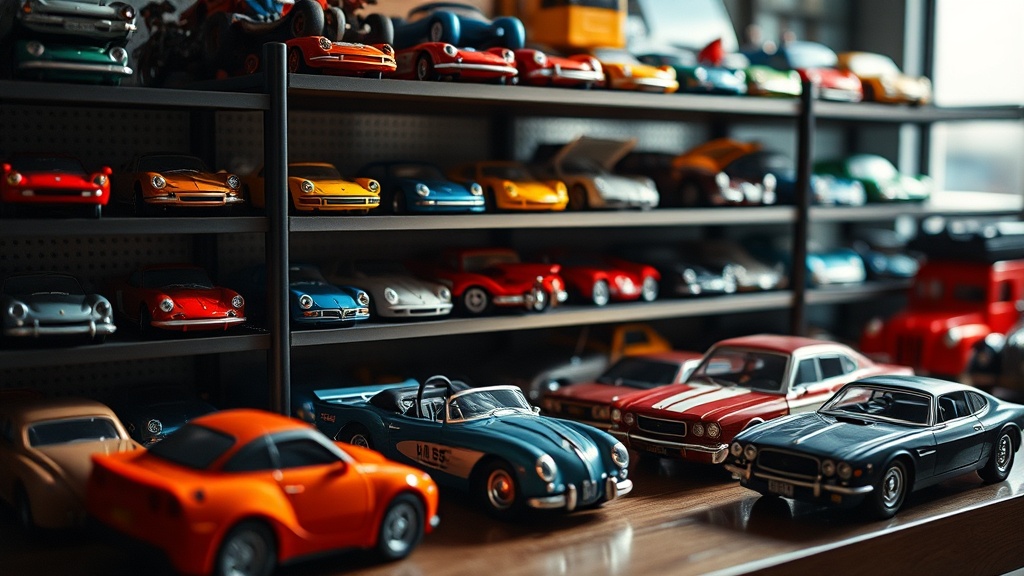
The Ultimate Guide to Storing and Protecting Your Diecast Car Collection

This guide covers the complete spectrum of diecast car storage and protection—from climate control and display cases to long-term archival methods. Whether you're safeguarding three generations of Dinky Toys or preserving a freshly unboxed Hot Wheels Super Treasure Hunt, the techniques here will help maintain paint integrity, prevent zinc pest, and keep your collection showroom-ready for decades.
What's the Best Way to Store Diecast Cars Long-Term?
The best long-term storage combines stable temperature (65-72°F), humidity control below 50%, acid-free materials, and protection from UV light. Diecast models are precision metal castings with paint, rubber, and sometimes plastic components—each reacting differently to environmental stress.
Temperature swings cause metal expansion and contraction. That's micro-movement at the paint-to-metal interface, and eventually, that paint's going to lift or craze. Humidity above 55% invites oxidation on bare metal bases, window trim, and those delicate axle ends. The rubber tires? They'll degrade faster in damp conditions—becoming cracked, sticky, or misshapen.
Here's the thing: most collectors think "display case" and stop there. But the environment around that case matters just as much. A sealed acrylic case sitting in a sun-drenched room or damp basement defeats the purpose. The goal is a microclimate—controlled, consistent, and buffered against external swings.
For serious collections, consider dedicated storage rooms or closets with a portable dehumidifier like the hOmeLabs 1,500 Sq. Ft. model. In drier climates, a small humidifier prevents the opposite problem—dried-out tire rubber and brittle plastic parts. A basic digital hygrometer (ThermoPro makes reliable units for under $15) lets you monitor conditions without guesswork.
The catch? Basements and attics are rarely suitable despite their convenience. Basements flood, harbor mold, and swing between humid summers and dry winters. Attics bake—reaching 120°F+ in summer and dropping below freezing in winter. Interior closets, conditioned living spaces, or purpose-built cabinets are the only real options for valuable pieces.
Storage Method Comparison
| Method | Best For | Pros | Cons |
|---|---|---|---|
| Original blister packs | Modern collectibles, investment pieces | Mint condition, maximum resale | Bulky, yellowing plastic, no display value |
| Acrylic display cases | Opened premium models, showpieces | Dust protection, UV filtering options, stackable | Cost, static buildup attracts dust |
| Stackable bins with dividers | Large collections, loose models | Space-efficient, affordable, portable | Contact friction, limited protection |
| Custom cabinet shelving | Permanent collections, serious collectors | Tailored climate control, showcase quality | Expense, permanent installation |
How Do You Prevent Diecast Cars From Deteriorating?
Preventing deterioration requires understanding the enemy—zinc pest, UV degradation, off-gassing from materials, and physical contact damage. Each threat demands specific countermeasures.
Zinc pest (zinc rot) is the collector's nightmare. Pre-1960s diecast often contains impure zinc alloys that, over decades, undergo intercrystalline corrosion. The metal literally expands, cracks, and crumbles from within—destroying the casting irreversibly. There's no cure. Prevention means keeping relative humidity low enough that the electrochemical reaction can't proceed. Once started, it's terminal.
That said, not all vintage diecast is doomed. Dinky Toys from the 1950s, properly stored in arid conditions, remain pristine. The same models left in coastal humidity can turn to dust. If you're collecting pre-1970 pieces, a silica gel dehumidifier like the Eva-Dry E-333 inside each storage container isn't optional—it's basic preservation.
UV light fades paint and degrades plastic. Fluorescent tubes emit enough UV to cause noticeable fading over 5-10 years of continuous exposure. Window-filtered sunlight does it faster. Solution? LED display lighting (warm white, 2700K-3000K), UV-filtering acrylic cases, or simply positioning collections away from direct light sources. The National Park Service conservation guidelines on light damage offer excellent technical depth for the curious.
Off-gassing is the silent killer. Cheap foam, certain woods (especially oak and cedar), PVC plastics, and some adhesives release acids and plasticizers over time. These volatiles condense on nearby surfaces, creating a sticky film that etches paint and clouds clear plastic windows. Never store diecast in contact with foam inserts unless they're specifically archival-grade polyethylene or polypropylene. Ditto for wooden shelves—seal them with polyurethane or line with acid-free paper.
Worth noting: those magnetic acrylic cases popular with LEGO collectors? The magnets themselves don't harm diecast, but the closed-cell foam gaskets often used for sealing can off-gas. Stick to pure acrylic cases with gasket-free closures, or cases using silicone gaskets.
The Handling Protocol
Even clean hands leave oils. For high-value pieces, cotton gloves (nitrile works in a pinch) prevent fingerprints that etch into paint over years. Always lift by the base—never the roof, never the mirrors. Those wing mirrors on a 1:18 scale model? They're often pot metal cast hollow, with wall thickness under a millimeter. They'll snap if used as leverage points.
When rotating displays or photographing inventory, work over a soft surface. A towel on the table costs nothing. A chipped fender on a vintage Corgi Aston Martin DB5 costs hundreds in value loss.
Should Diecast Cars Be Stored in Their Original Packaging?
It depends entirely on your collecting goals and the specific piece. Carded blister packs offer maximum investment protection for modern collectibles but create display and storage challenges that many collectors underestimate.
For Hot Wheels mainlines, Matchbox, and similar mass-market items produced after 1990, the blister-to-card construction uses PVC bubbles heat-sealed to cardboard. That PVC yellows, becomes brittle, and eventually cracks. The cardboard absorbs moisture, warps, and provides zero crush protection. A stack of carded cars three feet high exerts enough pressure on the bottom units to permanently crease cards.
Here's the thing: if you're holding sealed product as an investment, graded and slabbed is the only serious option. Companies like CGC Cards and AFA (Action Figure Authority) encase carded items in archival acrylic with tamper-evident sealing. The service costs $20-50 per item, but for a $500 Super Treasure Hunt, it's insurance.
For opened premium models—AUTOart, Kyosho, Minichamps, BBR—the original foam-lined boxes are actually excellent storage solutions. These manufacturers use chemically stable polyethylene foam that won't off-gas. The boxes themselves are sturdy, stackable, and protect against light and dust. Many serious collectors keep premiums boxed with the acrylic display case (included with most $200+ models) as the everyday display option.
That said, there's a middle path worth considering. For loose vintage pieces where original packaging is long gone, custom acrylic cases from specialty retailers like Model Car World or Diecast Aircraft Forum vendors provide museum-grade protection. Expect to pay $15-40 per case depending on scale—expensive for a hundred-car collection, reasonable for a dozen showpieces.
The Storage Hierarchy
Think in tiers:
- Archival vault: Climate-controlled, dark, minimal handling. For investment-grade sealed product and irreplaceable vintage pieces.
- Active collection: Displayed in UV-filtered cases, dusted monthly, rotated seasonally. The pieces you actually enjoy.
- Working inventory: Bins, drawer cabinets, or shelf systems for project cars, duplicates, and trade stock. Functional, accessible, protected enough.
This three-tier approach prevents the common trap of either (A) keeping everything sealed and never enjoying it, or (B) displaying everything and accelerating deterioration on pieces that deserved better.
What About Display and Daily Protection?
Active display demands its own set of precautions. The goal is balancing visibility with preservation—no small feat when dust, accidental bumps, and curious hands are daily realities.
Closed display cases beat open shelving every time. Dust isn't just unsightly; it's abrasive. Microscopic particles settle, get moved by air currents, and act like fine sandpaper on painted surfaces. A closed case with a tight seal reduces dust accumulation by 90% or more. The best cases use magnetic closures or sliding acrylic doors that maintain seal integrity without creating opening stress points.
For shelving, solid wood or MDF with a hard surface finish beats wire racks or rough-cut timber. Wire creates pressure points. Rough wood snags tires and undercarriage details. Glass shelves look elegant but scratch—acrylic shelving is more forgiving.
The catch? Static electricity. Acrylic cases build static charge that attracts dust to their interiors. An anti-static brush (the kind sold for record cleaning) used monthly keeps interiors pristine. Never use compressed air—it propels dust particles at velocity against paint, potentially causing micro-scratches visible under magnification.
Insurance and Documentation
A collection worth protecting is worth documenting. Photograph each piece from multiple angles, record purchase details, and maintain a spreadsheet with current market values. High-value collections should be scheduled on a dedicated collectibles insurance policy—standard homeowner's coverage often caps hobby collections at $1,000-2,500 and excludes "business inventory" (which interpreted broadly, can include investment-grade collectibles).
Companies like Collectibles Insurance Services and American Collectors Insurance specialize in this coverage. Premiums run roughly 0.5-1% of insured value annually—reasonable protection for decades of careful curation.
One final consideration: the human element. If children, pets, or clumsy adults share your space, wall-mounted display cases eliminate the "bump factor." They're harder to dust, harder to rearrange, but impossible to accidentally sweep off a coffee table. For irreplaceable pieces, that trade-off is worth making.
"A well-stored diecast collection isn't hidden—it's preserved for the moment it matters. The 1950s Dinky Supertoy that's pristine today because someone bothered with climate control in 1985? That's the piece that funds a semester of college in 2045."
The best storage solution is the one you'll actually maintain. A climate-controlled vault does nothing if accessing your cars becomes such a chore that you never rotate displays. An imperfect system you use beats a perfect system you abandon. Start with the fundamentals—stable temperature, low humidity, UV protection, and clean handling—and refine as your collection (and commitment) grows.