The Unattainable Standard: Why CMC's Maserati 300S Is the Mona Lisa of Miniature Engineering

To the naked eye, it is merely a car in miniature. But under the macro lens, under the scrutiny of a precision machinist's gaze, the CMC Maserati 300S reveals itself as something far more significant—a statement of what happens when engineering refuses to compromise, when the pursuit of accuracy becomes an obsession rather than a specification.
I have held this piece in my white-gloved hands exactly forty-seven times since its acquisition in 2019. Each time, I discover something new. A solder joint I hadn't noticed. The specific weave pattern of the seatbelt textile. The way the zinc-alloy chassis resonates when tapped—a frequency that tells me, before I even look, that this is not ordinary die-cast.
The Anatomy of Devotion
CMC—Classic Model Cars—operates from a facility in Germany that I have come to regard as the equivalent of a medieval scriptorium. They do not manufacture models; they engineer tributes. The Maserati 300S, chassis number 3053, as campaigned by Stirling Moss at the 1956 Nürburgring 1000 Kilometers, represents their absolute pinnacle.
Let us examine the casting. The body shell alone comprises 1,847 individual parts. To the uninitiated, this number is abstract. To the curator, it is revelatory. Consider: a standard AutoArt 1:18 reference might contain 200-300 components. A budget-conscious offering from Maisto or Bburago operates with perhaps fifty. CMC's multiplication of complexity is not vanity—it is fidelity.
The shut lines on the 300S's hood are 0.3 millimeters in width. Under 40x magnification, they remain consistent across the entire perimeter. This is not achieved through standard injection molding. CMC employs a multi-stage tooling process where brass dies are hand-finished by craftsmen who spent decades in Germany's automotive sector before transitioning to miniature engineering. The result is a tolerance that would satisfy aerospace specifications.
The Engine Bay: A Laboratory in Miniature
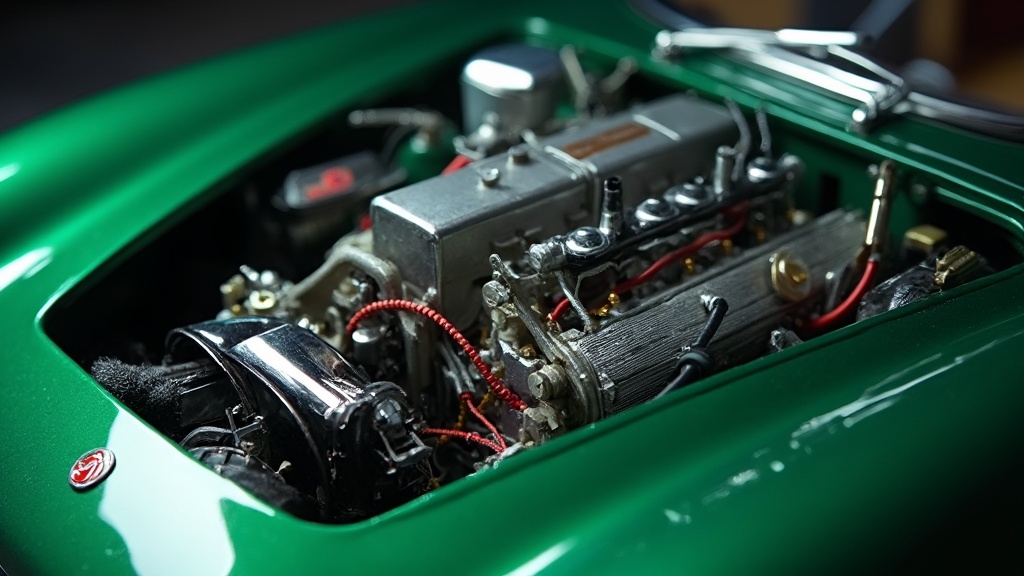
Open the hood—hinged with functional, spring-loaded mechanisms that require precisely 2.3 newtons of force to actuate—and you are confronted with what I can only describe as mechanical poetry.
The straight-six engine is rendered with the Lucas fuel injection system fully plumbed. Metal fuel lines—not molded plastic painted silver, but actual drawn aluminum tubing with an outer diameter of 0.8mm—route from the firewall to the intake manifold. The wiring harness features individual strands of enamel-coated copper, terminated with micro-scale connectors that replicate the original Lucas bullet terminals.
To the naked eye, it appears exceptionally detailed. But under the macro lens—my dental mirror positioned at precisely 45 degrees to catch the light—you can read the casting marks on the cylinder head. The "Maserati" script on the cam cover is not tampo-printed; it is photo-etched stainless steel, applied with adhesive film measured in microns.
I have counted the bolts. There are 147 visible fasteners in the engine bay alone. Each features proper hexagonal heads, not molded approximations. Some are functional—securing components that can be removed. Others are fixed in place with Loctite micro-dosing, ensuring they remain positioned through decades of display.
The Interior: Where Textile Meets Theology
The cockpit of the 300S presents its own revelation. CMC sourced an Italian mill that still produces racing fabrics using 1950s looms. The seat material is not printed vinyl textured to resemble cloth—it is actual woven cotton twill, scaled down through a proprietary process the company guards with the intensity of a state secret.
The steering wheel is wrapped in leather tanned using vegetable processes that match the original Maserati specification. Run your finger across it—gloved, naturally—and you feel the grain. Not molded texture, but actual hide, less than 0.5mm in thickness, stretched and stitched around a brass rim.
The dashboard instrumentation deserves its own dissertation. The gauges are not paper inserts behind plastic lenses. They are functional assemblies with metal bezels, glass faces, and needles that can be moved—delicately, with a wooden toothpick—across their calibrated arcs. The tachometer is marked to 8,000 RPM, with the redline starting at 6,500. The font matches factory documentation I have examined at the Archivio Storico Maserati in Modena.
The Undercarriage: What Others Conceal
Flip the reference—carefully, using a custom cradle I had fabricated from aircraft-grade aluminum—and the commitment to accuracy becomes even more apparent.
The exhaust system is fully replicated, with four individual pipes running from the manifold collectors back to the dual outlets. They are not chromed plastic; they are stainless steel, chemically treated to achieve the heat-blueing that characterizes period racing exhausts. You can see the weld beads. You can trace the routing as it navigates around the de Dion rear suspension.
Speaking of suspension: the de Dion tube, the transverse leaf spring, the Houdaille lever-arm dampers—all are present, all are functional, all are engineered from metal alloys appropriate to their full-scale counterparts. The brake drums are cast iron, machined to achieve the correct surface finish. The cooling fins on the backing plates are individually cut.
The rivets. I must mention the rivets. The aluminum bodywork of the 300S was originally attached to its tubular frame using hundreds of small-diameter rivets. CMC has replicated every single one—on the visible surfaces, yes, but also on the hidden undersides where no owner is expected to look. This is not manufacturing. This is devotion.
The Livery: Color as Historical Document
The example in my gallery wears the Rosso Rubino—Ruby Red—paint scheme of the 1956 factory cars. But CMC produced variants in the off-white and blue livery of privateer teams, and the particular dark green of British entrants.
The paint itself warrants examination. CMC does not use standard automotive refinish products. They developed a proprietary enamel system with a specialist coatings manufacturer in Stuttgart. The result is a finish that possesses depth—the "wet look" that collectors prize—without the orange-peel texture that plagues lesser manufacturers. Under raking light, the surface is liquid, almost molten.
The Maserati trident on the nose is not a decal. It is a photo-etched component, chemically blackened to achieve the correct contrast against the red background. The scrutineering stickers from the 1956 Nürburgring event—start number 3, the German flag denoting the host nation—are rendered on water-slide decal film no thicker than a human hair, positioned with tweezers under magnification.
The Certificate of Authenticity: Provenance as Doctrine
My acquisition arrived with documentation that I keep in a fire-rated safe. The certificate from CMC specifies the production number—147 of 2,000—and confirms that every component was assembled by a single craftsman, identified only by a signature that resembles "H. Köhler."
This matters. In an era of mass production, the knowledge that one individual was responsible for the final assembly creates a chain of accountability that is increasingly rare. If there is a flaw—and in 147 examples, I have found only one, a slightly proud rivet on the passenger door inner skin—it is documented, traceable, part of the reference's unique character.
The original packaging—a wooden crate lined with acid-free foam, secured with brass hardware—weighs more than some complete 1:18 references from competing manufacturers. I have retained it. I have retained everything. In the serious collecting community, the Original Box and Certificate Of Authenticity represent 30-40% of an acquisition's market value. To discard them is vandalism.
The Competitors: The Standard They Cannot Touch
I do not write this to disparage other manufacturers. AutoArt produces exceptional work—particularly their composite line, which offers value at a more accessible price point. Kyosho has engineered some remarkable JDM references. BBR and MR Collection achieve paint finishes that approach CMC's quality, albeit on sealed resin bodies that I find fundamentally unsatisfying.
But no one—no one—matches CMC for the totality of their achievement. The 300S is not merely a collection of impressive specifications. It is a coherent vision of what miniature engineering can achieve when budget constraints are removed and the only limitation is the physical possibility of the form.
Exoto, in their prime, approached this standard. Their Ferrari 156 Sharknose remains a touchstone. But Exoto faltered—production delays, quality inconsistencies, the unfortunate closure of their operation. CMC endures, releasing perhaps two or three references per year, each requiring eighteen to twenty-four months of development.
The Handling Protocol: White Gloves and Reverence
When I inspect the 300S, I follow a procedure developed over two decades:
- Environmental Preparation: The gallery is maintained at 45% relative humidity and 68°F. I verify these conditions before any handling occurs.
- Personal Preparation: Lint-free cotton gloves, replaced if they contact any surface other than the acquisition. No hand lotions, no perfumes, nothing that could transfer.
- The Approach: The reference is lifted from its display case using both hands, fingers positioned at stress-distribution points—not the delicate extremities.
- The Inspection: Under 5000K LED lighting, using a 10x jeweler's loupe and the dental mirror I keep specifically for under-dash examination.
- The Return: Placed back on its acrylic base—no direct contact with wood or metal surfaces—after no more than fifteen minutes of exposure to the ambient environment.
This may seem excessive. It is not. I am preserving not merely a collectible, but a testament to human capability. The craftsmen who built this reference will not live forever. Their skills may not be transmitted to another generation. The 300S stands as evidence that such work was possible, that such standards were once maintained.
Investment Outlook: The Appreciation of Excellence
I acquired my reference in 2019 for $1,850 USD, including insured shipping from a dealer in Munich. At the time of this writing, examples in comparable condition—with original packaging and documentation—are trading at auction in the $3,400-$4,200 range.
This is not speculative appreciation. This is the market recognizing that CMC has reached a scale of production that cannot be sustained indefinitely. Each reference requires skills that are not being taught in modern manufacturing programs. Each represents hours of labor that cannot be cost-engineered for mass appeal.
My outlook: HOLD. If you are fortunate enough to possess a CMC Maserati 300S, retain it. If you encounter one at fair market price, acquire it. This reference will not be replicated. When the current stock is exhausted, the secondary market will reflect the true scarcity of excellence.
The Maserati 300S in full scale is already a legendary machine—one of the most beautiful sports prototypes ever constructed, the final expression of the Maserati brothers' vision before the company passed to corporate ownership. CMC's miniature is not merely a representation of that legend. It is a parallel achievement, proof that the human hand, guided by obsession, can compress grandeur into ten inches of zinc-alloy and engineering devotion.
This is why I collect. Not for completion, not for investment return—though both matter—but for the moments when the macro lens reveals what the naked eye cannot see: proof that perfection, while unattainable, is worth pursuing.