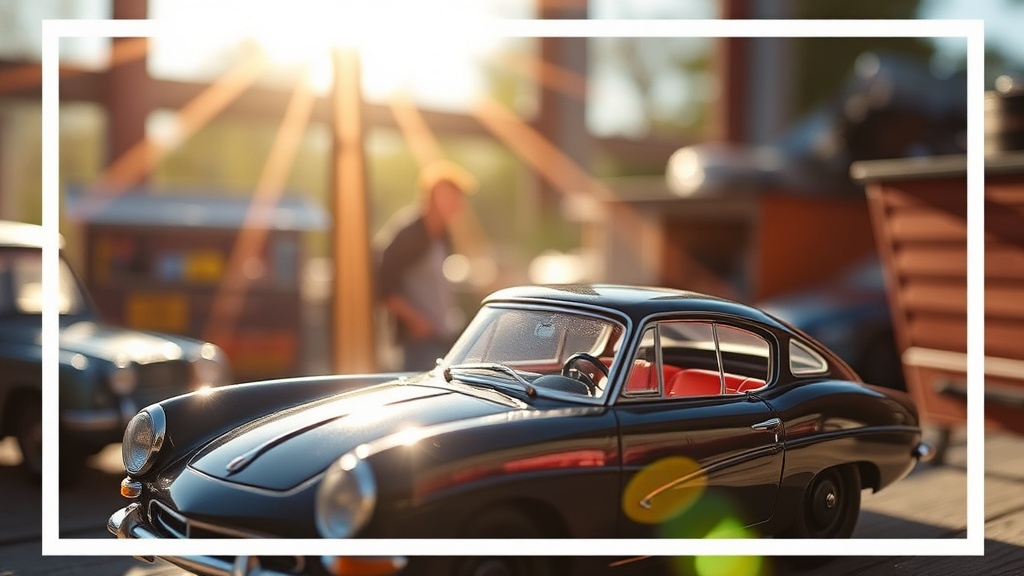
Why You Should Avoid Direct Sunlight for Your Diecast Models

Quick Tip
Keep your collection away from direct sunlight to prevent irreversible paint fading and plastic degradation.
Protecting Your Investment from UV Degradation
This post explains the specific mechanical and chemical damage caused by direct sunlight to diecast models and provides actionable steps to prevent permanent degradation. Understanding how ultraviolet (UV) radiation interacts with paint, plastic, and metal is essential for maintaining the long-term value and structural integrity of your collection.
The Science of Photodegradation
Direct sunlight delivers high-energy UV rays that trigger a process known as photodegradation. In the context of high-end diecast models, such as those from AutoArt or Minichamps, this damage manifests in three primary ways:
- Paint Oxidation: UV rays break down the chemical bonds in the clear coat and pigment. This leads to "chalking," where the finish becomes dull and loses its luster, or total color shifting.
- Plastic Embrittlement: The interior components—such as dashboard assemblies, steering wheels, and window tinting—are often made of ABS or polystyrene. Constant heat and UV exposure cause these polymers to become brittle, leading to cracks or even total failure of delicate parts.
- Decal Degradation: For models featuring water-slide decals or tampo printing, sunlight can cause the graphics to peel or fade significantly faster than the base paint.
If you notice your models losing their vibrancy, you may be experiencing the early stages of color loss over time due to environmental exposure.
Practical Prevention Strategies
To preserve the precision engineering of your models, you must control the environment in which they are displayed. Follow these technical guidelines to ensure your collection remains in mint condition:
- Avoid Window Placement: Never place display shelves directly opposite or adjacent to a window. Even indirect sunlight can accumulate enough thermal energy to damage sensitive parts.
- Utilize UV-Filtering Materials: If you display your collection in a room with natural light, apply a professional-grade UV-filtering film to the window glass. This significantly reduces the amount of harmful radiation entering the space.
- Implement Controlled Lighting: Instead of natural light, use LED lighting for your displays. LEDs emit significantly less heat and almost no UV radiation compared to incandescent or halogen bulbs, making them the safest option for long-term exhibition.
- Use Protective Enclosures: High-quality enclosures can act as a secondary barrier. For instance, using acrylic cases can provide an extra layer of protection against dust and certain light frequencies.
Technical Note: Heat is as much an enemy as UV light. A model sitting in a sun-drenched display case can reach internal temperatures that accelerate the outgassing of plastics, leading to "fogging" on the interior of the windows.