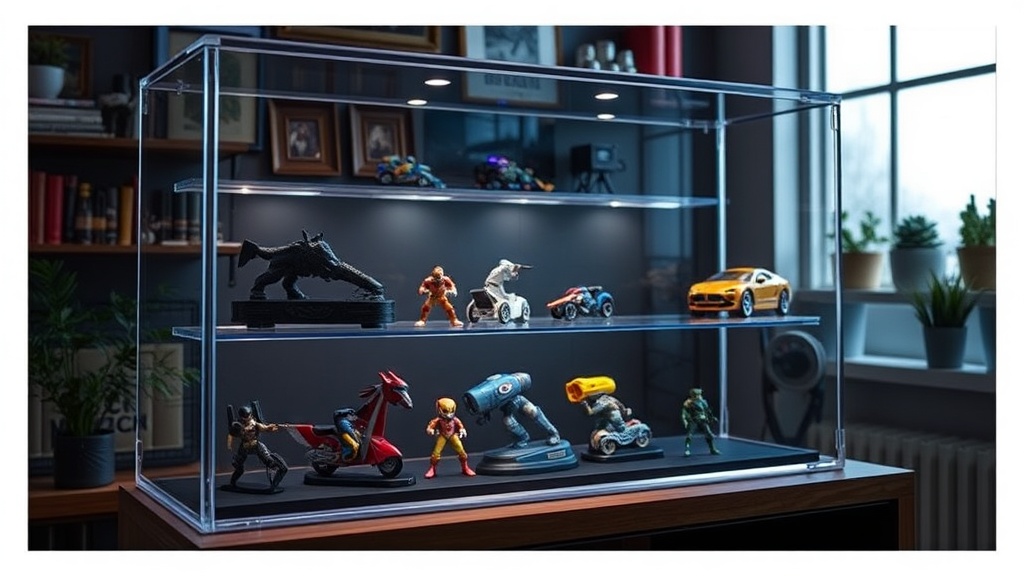
Building a Custom Acrylic Display Case for Your Collection

Dust is the silent enemy of any serious collector. A single speck of particulate matter can settle into the fine panel lines of a 1:18 scale Ferrari or obscure the intricate chrome detailing of a vintage Matchbox car. While high-end retail displays exist, they often fail to meet the specific dimensional requirements of a growing collection. This guide details how to design and construct a custom acrylic display case tailored to your specific scale models, ensuring they remain protected from UV light, dust, and physical contact.
A high-quality display isn't just about aesthetics; it's about structural integrity. When I was working on the shop floor in automotive manufacturing, we didn't tolerate tolerances that were "close enough." In the world of diecast, a case that wobbles or has gaps is a failure. You want a rigid, clear housing that treats your models like the engineering feats they are.
What Type of Acrylic Should You Use?
You should use high-grade cast acrylic rather than extruded acrylic for your display cases. Cast acrylic offers much better optical clarity and is far more resistant to chemical cracking when you use adhesives. If you use the cheap stuff—the extruded variety found in many big-box craft stores—you'll likely see micro-fractures or "crazing" if you ever use a solvent-based glue.
The thickness of the sheet is your first major decision. For a small-scale display of 1:64 Hot Wheels, 2mm or 3mm sheets work fine. However, if you are housing heavy 1:18 scale models like those from Autoart or CMC, you need at least 5mm thickness to prevent bowing under the weight of the lid or internal shelving.
Here is a breakdown of the materials you'll encounter:
| Material Type | Clarity Rating | Best For | Durability |
|---|---|---|---|
| Cast Acrylic | Excellent | Premium 1:18 Scale Collections | High (Resistant to cracking) |
| Extruded Acrylic | Good | Budget 1:64 Displays | Low (Prone to stress fractures) |
| Polycarbonate | Great | High-impact/Moving displays | Very High (Nearly unbreakable) |
One thing to remember: acrylic is incredibly easy to scratch. Even a soft microfiber cloth can leave a mark if you aren't careful. This is why maintaining a strict white-glove handling protocol is vital even during the construction process. You don't want to scratch your display before the cars even get inside.
How Do You Build a Custom Acrylic Case?
Building a custom case involves three main stages: cutting the panels, joining the edges, and mounting the interior. You can either order pre-cut panels from a service like Acrylages or a local plastic fabricator, or you can attempt to cut them yourself using a fine-tooth saw and a steady hand.
If you're cutting the material yourself, follow these steps:
- Drafting: Draw your panels on the protective film of the acrylic. Always include a 0.5mm "tolerance gap" for your joints.
- Cutting: Use a high-speed rotary tool or a fine-tooth saw. If using a saw, keep the speed constant to prevent melting the plastic.
- Sanding: Sand the edges with progressively finer grits of sandpaper (starting at 400 and ending at 1000). The edges must be perfectly flat for a seamless look.
- Cleaning: Remove all oils and dust from the edges using Isopropyl alcohol. Any residue will ruin your bond.
- Bonding: Use a specialized acrylic cement (like Weld-On 3 or 4) which works via capillary action to chemically fuse the pieces together.
The bond is where most hobbyists fail. You don't just "glue" the edges; you use the solvent to melt the two surfaces into one single piece of plastic. It's a chemical weld, not a surface-level adhesion. It's a subtle distinction, but it's the difference between a case that holds for a month and one that lasts a lifetime.
Don't forget the base. A heavy, weighted base—perhaps a piece of polished wood or a thick slab of black acrylic—provides the center of gravity needed to prevent tipping. A top-heavy display is a recipe for a broken 1:18 scale model hitting a hard floor.
How Can You Prevent Yellowing and UV Damage?
To prevent yellowing, you must use UV-resistant acrylic and keep your display away from direct sunlight. Even the highest quality plastics will eventually degrade under constant ultraviolet exposure, which can also cause the paint on your diecast models to fade or "chalk."
I've seen many collectors lose the vibrant red of a 1:18 scale Ferrari because they placed the display on a windowsill. The sunlight doesn't just hit the car; it penetrates the acrylic and creates a greenhouse effect inside the case. This heat can also soften certain types of decals or even affect the rubber tires over long periods. If you're serious about preservation, look into ultraviolet radiation protection by using UV-filtering films or placing the case in a controlled indoor environment.
If you notice any yellowing on your current displays, it might be a sign of low-quality material or environmental exposure. It's worth noting that the yellowing of the plastic is often a precursor to the degradation of the model's packaging, a common issue discussed in our post regarding why diecast packaging yellows.
A quick tip for lighting: if you want to illuminate your case, use LED strips. Traditional incandescent bulbs generate heat, and heat is the enemy of both the acrylic and the diecast finish. LEDs stay cool, which means your display stays stable. Avoid any light source that produces even a hint of warmth. Your models deserve a controlled environment, not a heat chamber.
When you're designing the interior, consider the "viewing angle." If you're displaying a heavy car, a single flat shelf might not be enough. You might want to build tiered "steps" into the base. This allows the cars in the back to be visible over the cars in the front. It turns a simple box into a professional-grade exhibition.
Precision is everything. If your edges aren't perfectly square, your case will never be truly airtight. A truly airtight case is the gold standard for preventing dust intrusion. It requires a perfect fit and a successful chemical weld. If you find yourself struggling with the assembly, don't be afraid to slow down. In my two decades of manufacturing, I learned that rushing a bond is the fastest way to end up with a failed part. Take your time with the solvent. Let the pieces sit. The patience you put into the build is what ensures the longevity of your collection.
Steps
- 1
Measure Your Collection Dimensions
- 2
Select High-Clarity Acrylic Material
- 3
Assemble the Base and Side Panels
- 4
Secure the Dust-Proof Lid