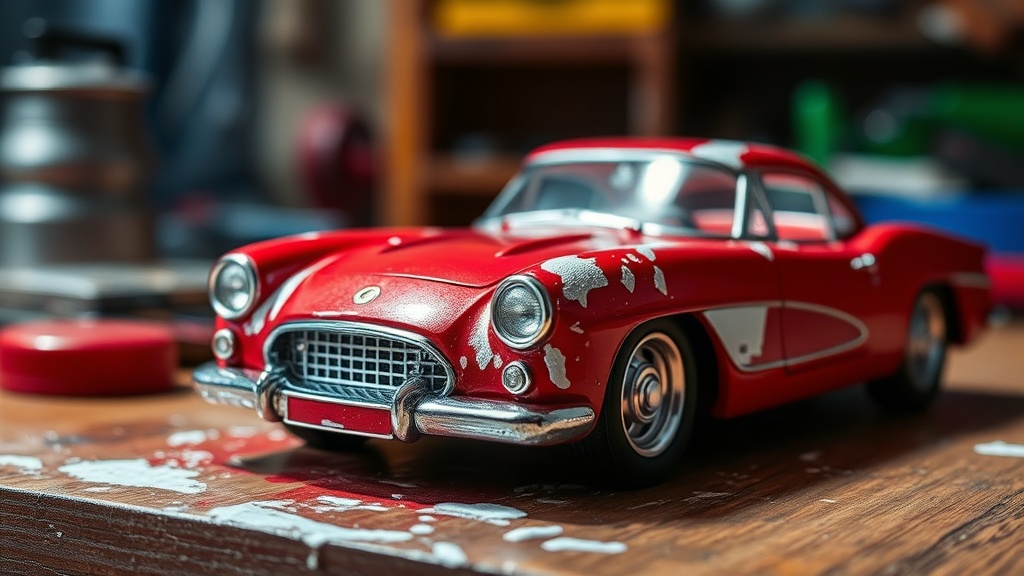
Why Your Diecast Model Paint is Peeling or Bubbling

A collector opens a pristine, unopened 1:18 scale display case only to find a small, raised bubble beneath the lacquer on the hood of a vintage Ferrari. Upon closer inspection, the paint isn't just bubbling; it is flaking away in tiny, sharp chips, revealing a dull, greyish metal underneath. This phenomenon—paint failure—is one of the most frustrating experiences for a serious enthusiast because it often happens even when a model has been kept in a controlled environment. This post examines the technical causes of paint peeling and bubbling in diecast models, ranging from manufacturing defects to environmental degradation, so you can identify the root cause and prevent further damage to your collection.
The Chemistry of Adhesion: Why Paint Fails
To understand why paint fails, you must view a diecast model not as a single object, but as a multi-layered engineered assembly. A standard high-quality model consists of the base metal (usually a zinc alloy or ZAMAK), a surface preparation layer (often a phosphate or electroplated coating), the color coat (the pigment), and the clear coat (the protective lacquer). When any of these layers fail to bond with the layer beneath it, the structural integrity of the finish is compromised.
The most common reason for peeling is a failure of adhesion. This occurs when the chemical bond between the substrate (the metal) and the paint is interrupted. In a precision manufacturing environment, this is often caused by microscopic contaminants like oils, fingerprints, or even residual moisture left on the metal before the paint is applied. If a factory line in a facility like those used by Autoart or Minichamps has even a slight deviation in their cleaning protocols, the resulting model will be a "ticking time bomb" of paint failure.
Common Causes of Bubbling and Blistering
Bubbling is distinct from peeling. While peeling involves the paint lifting off in sheets, bubbling (or blistering) is characterized by small, raised domes under the surface. This is almost always a sign of outgassing or trapped volatiles.
1. Trapped Solvents and Outgassing
During the curing process, the solvents in the paint must evaporate completely. If the clear coat is applied too heavily or too quickly before the base color coat has fully "off-gassed," the solvent vapors become trapped. As the temperature in the room fluctuates, these trapped gases expand, pushing the clear coat upward to create a bubble. This is a common defect in lower-tier mass-produced models where production speed is prioritized over curing time.
2. Moisture Entrapment and Oxidation
If moisture is present between the metal substrate and the paint layer, it can cause localized oxidation. Even if the metal isn't "rusting" in the traditional sense, a microscopic layer of oxidation acts as a barrier that prevents the paint from sticking. This is particularly prevalent in models with inferior plating. If you notice bubbles appearing specifically around the seams or edges of a model, it is likely that moisture has found a way into the micro-fissures of the paint.
3. Thermal Expansion Discrepancies
Different materials expand and contract at different rates when exposed to heat. The metal body of a diecast car has a much higher thermal conductivity than the polymer-based paint layers. If a model is subjected to rapid temperature shifts, the metal expands while the paint remains relatively static, creating mechanical stress that results in micro-cracking or bubbling. This is why you should avoid direct sunlight for your diecast models, as UV rays and heat are the primary drivers of this thermal stress.
The Role of Substrate Integrity: Zinc Pest and Metal Degradation
Sometimes, the paint failure is not a paint problem, but a metal problem. If the underlying alloy is unstable, no amount of high-quality lacquer will keep the finish intact. A significant concern for collectors of vintage or certain mid-tier diecast models is zinc pest (also known as intergranular corrosion).
When the zinc alloy used in the casting is contaminated with impurities like aluminum or tin, the metal undergoes a slow chemical breakdown. As the metal structure expands or shrinks due to this internal corrosion, it creates pressure against the paint layer from the inside out. This often manifests as the paint bubbling and then cracking as the metal underneath physically changes shape. If you see the paint bubbling alongside a slight swelling or warping of the car's body panels, you are likely looking at a metallurgical failure rather than a simple coating issue. You may want to check your diecast models for zinc pest to confirm this diagnosis.
Environmental Factors in the Display Case
Even a high-quality model can succumb to paint failure if the display environment is poorly managed. As a curator, you must control the three pillars of preservation: light, temperature, and humidity.
- Humidity: High humidity levels can facilitate the movement of water molecules through the microscopic pores of the paint. Once moisture reaches the metal, it triggers the oxidation processes mentioned above.
- Chemical Outgassing from Display Bases: Many collectors use aftermarket acrylic or plastic display cases. Some lower-quality plastics or adhesives used in display bases can "off-gas" volatile organic compounds (VOCs). These gases can react with the clear coat of the model, softening it and causing it to bubble or become tacky.
- Dust and Particulates: While dust seems harmless, a buildup of organic matter (like skin cells or household dust) can hold moisture against the surface of the model, creating localized "micro-climates" that can degrade the finish over several years.
How to Identify and Categorize Your Damage
Before attempting any "rescue" or restoration, you must accurately diagnose the type of failure you are seeing. Use a high-intensity LED light and a magnifying loupe to inspect the area. Use the following checklist to categorize the damage:
- Surface Flaking: The paint is lifting in clean, sharp edges. This is usually a failure of the adhesion between the paint and the metal.
- Micro-Bubbling: Small, circular bumps under the clear coat. This is usually solvent entrapment or outgassing.
- Crackle/Crazing: A web of tiny cracks across the surface. This is caused by thermal stress or UV degradation of the clear coat.
- Large-Scale Blistering: Large areas of paint lifting, often accompanied by visible metal underneath. This is a sign of sub-surface oxidation or zinc pest.
Prevention and Mitigation Strategies
While you cannot fix a manufacturing defect once a model is in your possession, you can mitigate the risk of environmental-induced paint failure through rigorous display management.
Maintain a Stable Micro-Climate: The ideal environment for a diecast collection is a room with a constant temperature (approx. 65-70°F) and a relative humidity of 40-50%. Avoid displaying models in attics, basements, or near HVAC vents, as the constant cycling of temperature and humidity is the fastest way to induce thermal stress and moisture-related bubbling.
Use UV-Filtered Glass: If your models are displayed in a room with natural light, ensure your display cases use UV-filtering acrylic or glass. UV radiation breaks down the polymer chains in the clear coat, making it brittle and prone to cracking. This is a critical step for collectors who own high-value pieces with delicate finishes.
Handle with Care: Human skin produces oils (sebum) and perspiration that are slightly acidic. If you touch the paint surface directly, these oils can eventually eat through the clear coat, especially in models with thinner paint applications. Always use lint-free cotton gloves when handling your models for cleaning or repositioning. This prevents the transfer of contaminants that could eventually lead to localized peeling.
By understanding the technical relationship between the metal substrate and the applied coatings, you can better protect your collection from the inevitable decay of time and environment. Treat your models not just as toys, but as the precision-engineered artifacts they are.